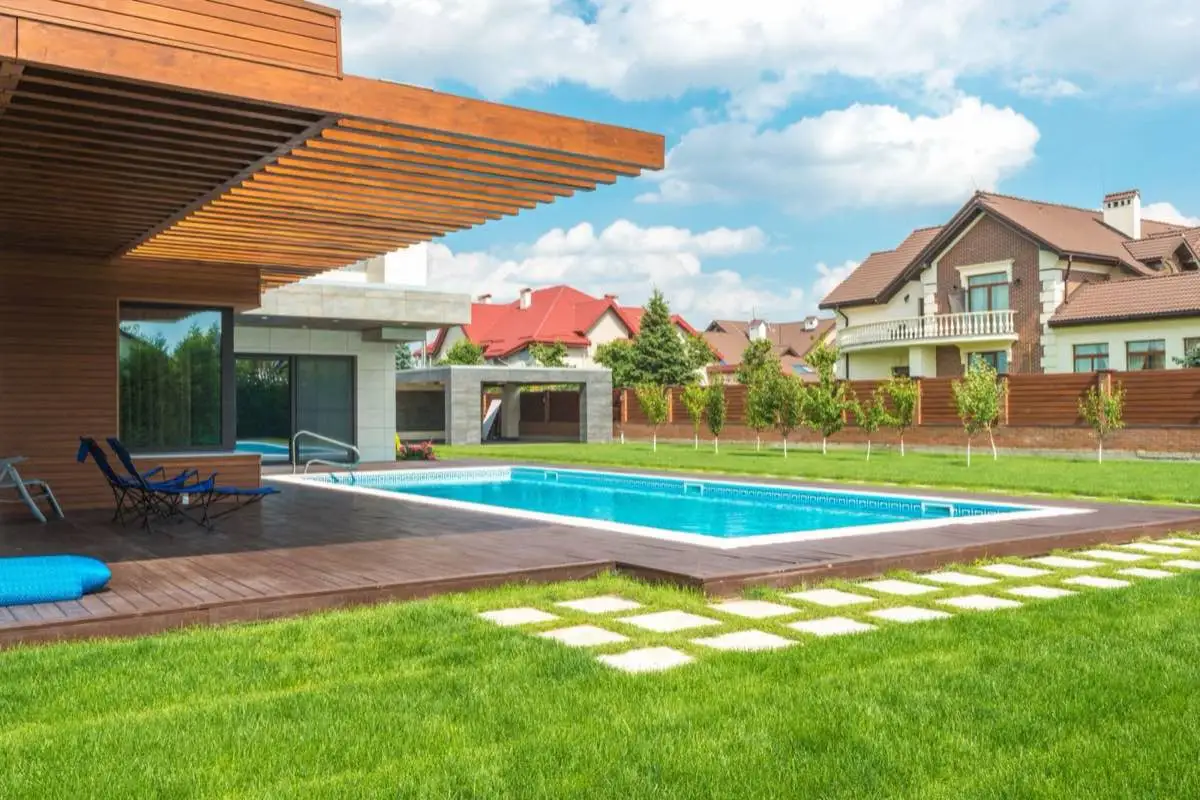
Straight answer on pool plaster vs pebble finish: plaster is cheaper up front and lasts 7 to 12 years, pebble costs roughly double and lasts 15 to 20. If you plan to own the pool through the next replaster cycle, pebble is the better math. If you might sell inside five years, white plaster and a nicer deck will do more for you.
Now the part the plaster crew tells you in the driveway and nobody puts on a website: every interior finish in the world is a sacrificial layer. It is cement holding stone, sitting in water that is chemically trying to dissolve it. Your job is picking how thick and how stubborn that layer is.
The three finishes you are actually choosing between
| Finish | What it is | Typical life | Typical installed cost, 16x32 pool |
|---|---|---|---|
| White plaster (marcite) | White portland cement + crushed marble dust | 7–12 years | $4,500–$7,000 |
| Quartz aggregate | Cement + crushed quartz (Diamond Brite, Krystalkrete) | 10–15 years | $6,000–$9,500 |
| Pebble | Cement + river pebble, exposed by washing (Pebble Tec, StoneScapes) | 15–20+ years | $8,000–$14,000 |
Those are interior-surface jobs including chip-out, waterline tile, and start-up. A deeper pool, a spa spillover, or a backyard your crew has to wheelbarrow through changes the number.
Plaster: the honest budget pick that gets unfairly trashed
White plaster has been the default pool interior since the 1950s for a reason. It is smooth, it is bright, it makes the water that classic blue, and it is the cheapest way to make a tired pool look new.
Its weaknesses are real though. It stains. Leaves, metals in the fill water, and a summer of neglected chemistry leave marks that never fully scrub out. And it is soft enough that aggressive water etches it — run your pH under 7.2 or let calcium hardness drop below about 200 ppm and you are chemically sandblasting your own pool.
You get maybe two or three acid washes out of a plaster surface in its life. Each one strips a thin layer to reveal clean material underneath. It works. It also brings the funeral closer every time.
Pebble: buy it for the years, not the looks
Pebble finishes embed small river stones in the cement matrix and then wash the surface so the stone sits proud. That exposed aggregate is the whole trick — a stain has nowhere flat to sit, and the surface has far more material to give up before it fails.
Two honest downsides. First, texture. Classic large-pebble finishes are genuinely rough, and the place you notice is the tanning ledge where a five-year-old parks for three hours. Polished pebble products grind the stone down and solve most of this, at a price.
Second, algae. All that texture is more surface area, so a pebble pool that goes green punishes you harder during cleanup. Not a dealbreaker, just a thing.
What actually kills a finish (it is not the finish)
Here is the part that decides more than the product choice: water chemistry, measured against the Langelier Saturation Index. Cement finishes want water that is slightly scale-forming, not slightly hungry.
Keep it in these lanes and any of the three lasts near the top of its range:
- pH: 7.4 to 7.6
- Total alkalinity: 80 to 120 ppm
- Calcium hardness: 200 to 400 ppm
- Cyanuric acid: 30 to 50 ppm in a sunny climate like the South Bay and the Gateway Cities
The first 28 days matter most. New plaster is still curing, and the start-up brushing schedule — twice a day for the first week or two, no salt for the first 30 days on a saltwater conversion — is not optional busywork. Skipping it is how a brand new $9,000 surface gets a mottled gray blotch that no chemical ever removes.
When you should not resurface at all
We would rather say this than sell you a job you do not need.
If the surface is stained but still smooth, do not resurface. Run your palm along the wall at the shallow end. If it feels like a dinner plate, you have plaster left. A proper drain-and-acid-wash usually runs $400 to $800 and buys another two to four seasons. Spending $9,000 to fix a color problem is a bad trade.
Resurface when you feel it, not when you see it. Rough enough to scrape a knee, exposed gray patches, plaster popping off in nickel-sized chips, or a floor that eats your pool vacuum — that is a structural conversation, not cosmetic.
The call we get every spring
The 1990s pool. Still holds water, pump still runs, but the plaster is the color of weak coffee and the owner has spent three seasons attacking it with a brush and a bottle of stain remover. They ask us to make it white again.
Sometimes an acid wash does it and everybody is happy for $600. About half the time the plaster is already thin enough that a wash would eat through, and the honest answer is that the surface is done. Both answers take ten minutes to reach with a hand on the wall. Neither one requires a sales pitch.
Our actual recommendation
Go pebble if you will own the pool past the next 10 years, and pick a polished pebble if you have young kids. The lifespan difference — call it 17 years against 9 — means pebble's higher price works out to about the same annual cost, and you skip an entire drain-refill-and-two-weeks-of-hassle cycle along the way.
Go white plaster if you are selling within five years, or if the budget is tight and you would rather put the difference into decking and coping, which is what guests actually look at.
Go quartz if you want color that holds without pebble money. It is the pick most people are happiest with a decade later.
Whichever way you land, the interior is also the only time the pool is empty — so it is the cheapest moment to add a remodel item like new waterline tile, a raised bond beam, or a spa. Doing that later means draining it again.
Long Beach Pool Pros handles pool resurfacing across Long Beach and the South Bay and the Gateway Cities in plaster, quartz, and pebble, and we will tell you when a $600 acid wash beats a $9,000 job. If you want the numbers for your specific pool, see our pool resurfacing cost breakdown or call (888) 523-7764.
Get a free quote → · call (888) 523-7764
Ready for a free quote in Long Beach?
Long Beach Pool Pros — free estimate, clear scope, no pressure. Use the form on this page or jump to the homepage quote.
Related services in Long Beach
Long Beach Pool Pros money pages — go straight to the service you need.
- Pool Remodeling & Renovation →
Pool remodeling in Long Beach turns a structurally sound but dated pool into something you actually want to look at, for a fraction of what a new pool costs. We remodel in layers so you can decide exactly where to stop, and the quote shows you what each layer buys.
- Pool Resurfacing & Replastering →
Long Beach Pool Pros resurfaces pools with finishes chosen for salt air, cool mornings, and heavy year-round bather use. Coastal plaster and pebble wear shows as etching, hollow spots, and staining along the waterline where salts and oils collect.
- Pool Lighting & LED Upgrades →
LED pool lighting in Long Beach is the best value upgrade in this entire trade: swapping a 500-watt incandescent fixture for a modern LED drops the draw to roughly 40 to 70 watts and turns a dim yellow puddle into something worth looking at from the kitchen window. We retrofit existing niches, replace whole fixtures, and install nicheless LEDs where the old niche is past saving.
- Gunite & Shotcrete Pool Construction →
A gunite shell is sprayed concrete over a tied steel cage, and in Long Beach the thing that decides how long it lasts is how much concrete covers that steel. Salt air gets a vote for the life of the pool.
- Waterline Tile & Coping Replacement →
Waterline tile and coping replacement in Long Beach is the cheapest way to make an ordinary pool look like a renovated one, because those two bands are the only part of the pool anyone actually looks at from a standing position. We replace failed tile and coping, or clean and reset what is salvageable, and rebuild the expansion joint properly while we are in there.
Frequently asked questions
Is pebble really better than plaster?
It lasts longer — commonly 15 to 20 years versus 7 to 12 for white plaster — and it hides staining far better. It also costs roughly double and feels rougher underfoot unless you pick a polished pebble like PebbleSheen or PebbleFina. Better for durability, not better for every budget.
How much does it cost to resurface a pool in Long Beach?
For a typical 16x32 pool with about 800 to 1,000 square feet of interior surface, white plaster generally runs $4,500 to $7,000 and pebble $8,000 to $14,000 installed, including chip-out, tile line, and start-up. Depth, tile, and access change it. Long Beach Pool Pros measures before quoting — call (888) 523-7764.
How long does a pool plaster finish last?
Standard white plaster typically gives 7 to 12 years. Water chemistry decides which end you land on. Pools run with low calcium hardness or pH below 7.2 for long stretches etch early, sometimes in five years.
Is pebble finish rough on your feet?
Classic large-aggregate pebble is, especially on a sun-shelf where kids sit. Polished pebble finishes grind the exposed stone down and feel closer to river rock than sandpaper. If you have small children, ask for a physical sample board and rub your thumb on it before you sign.
Can you put new plaster over old plaster?
A bond coat over existing plaster is possible, but only if the old surface is sound and well prepped. Full chip-out back to the gunite shell costs more and delaminates less. If a contractor skips chip-out on a surface that has already been resurfaced twice, walk away.
What is quartz finish and where does it fit?
Quartz finishes such as Diamond Brite or Krystalkrete blend crushed quartz into the cement. They sit between plaster and pebble on both price and lifespan — usually 10 to 15 years — and hold color better than plain plaster. It is the honest middle pick.
Local context
How this applies in Long Beach, CA
Every article here is written from pool work done in Long Beach and the South Bay and the Gateway Cities, so the numbers reflect local labour, permit and material costs rather than a national average. Your own job can land either side of them depending on access, the condition of what is already there, and the materials you pick — gunite and shotcrete construction, PebbleTec and quartz interior finishes, travertine coping and glass waterline tile.
The way to turn any of this into a real answer is to have someone look at your actual situation. The free estimate is free, itemized and written down, with no deposit and no obligation. Call (888) 523-7764 or start on the Long Beach Pool Pros homepage.
Areas Long Beach Pool Pros covers
Long Beach first, then the surrounding communities of the South Bay and the Gateway Cities. Each has its own page with local detail rather than a copy of this one:
- Lakewood, CA — Los Angeles County, population 82,500
- Signal Hill, CA — Los Angeles County, population 11,800
- Carson, CA — Los Angeles County, population 95,600
- Seal Beach, CA — Orange County, population 25,200
- Los Alamitos, CA — Orange County, population 11,800
- Cerritos, CA — Los Angeles County, population 49,600
Or jump to the full list of Long Beach services.
More from the Long Beach Pool Pros blog
- Pool Heater Cost in Long Beach: Gas, Pump or Solar
Pool heater cost in Long Beach, CA — install prices for gas, heat pump and solar, real running costs, and when you need no heater.
- Pool Deck Ideas for Long Beach Backyards That Hold Up
Pool deck ideas for Long Beach, CA — concrete, pavers, travertine and coatings compared on cost, foot temperature, and slip rating.
- Inground Pool Monthly Maintenance Cost: Long Beach
What an inground pool really costs per month in Long Beach, CA — chemicals, power, water, weekly service rates, and the repair fund nobody budgets for.
The Long Beach Pool Pros Team
pool specialists serving Long Beach, CA
Written by the Long Beach Pool Pros team — insured pool pros with 15+ years serving Long Beach, CA and the surrounding area.